By NorCal Limo Editorial Team | Sacramento, CA
Key Takeaways
- SMF is the fastest and least stressful for Sacramento-area travelers — 15 to 20 minutes from downtown, lowest parking rates, no bridge crossings
- OAK suits Bay Area-bound travelers — shorter drive than SFO, BART access, and competitive budget fares
- SFO is the strongest for international flights and the widest airline network — but carries the longest drive, highest parking rates, and most complex terminal layout
- Drive times from Downtown Sacramento: SMF (~15–20 min), OAK (~90–100 min), SFO (~100–120 min)
- Parking rates: SMF from $12/day, OAK up to $36/day, SFO up to $45/day on-site
- A confirmed private transfer eliminates the parking and traffic variables entirely
Introduction
The San Francisco Bay Area is one of North America’s most visited regions — home to nine counties, a population of 7.76 million, and some of the world’s most recognized landmarks. The Bay Area spans the East Bay, the South Bay, the North Bay, San Mateo County, Santa Clara County, Contra Costa County, Marin County, and Sonoma County. Within reach of the Central Valley, Napa Valley, and the Pacific Coast, it is a destination that attracts travelers year round — for Silicon Valley business, wine country leisure, and everything in between.
For anyone based in Sacramento or the greater Sacramento region making that trip, the airport decision is one of the first and most consequential choices. Three major airports serve the corridor: Sacramento International Airport (SMF), Oakland International Airport (OAK), and San Francisco International Airport (SFO). Each connects the region to the Bay Area and beyond — but with meaningfully different drive times, parking rates, flight networks, and ground transportation experiences.
This guide gives you the full comparison — verified data, honest tradeoffs, and a clear recommendation for every trip type.
Understanding the Bay Area and Northern California Airport Geography
The San Francisco Bay is the physical anchor of the region. The nine counties of the San Francisco Bay Area include San Francisco, the East Bay, the South Bay and Silicon Valley, San Mateo County, Santa Clara County, Contra Costa County, Marin County, and Sonoma County.
San Francisco is the largest Bay Area city, with a population of 883,305 as of 2020. San Jose is the heart of Silicon Valley’s technology industry. Oakland — home to the fifth-largest container shipping port in the US — anchors the East Bay. Marin County and Sonoma County form the North Bay.
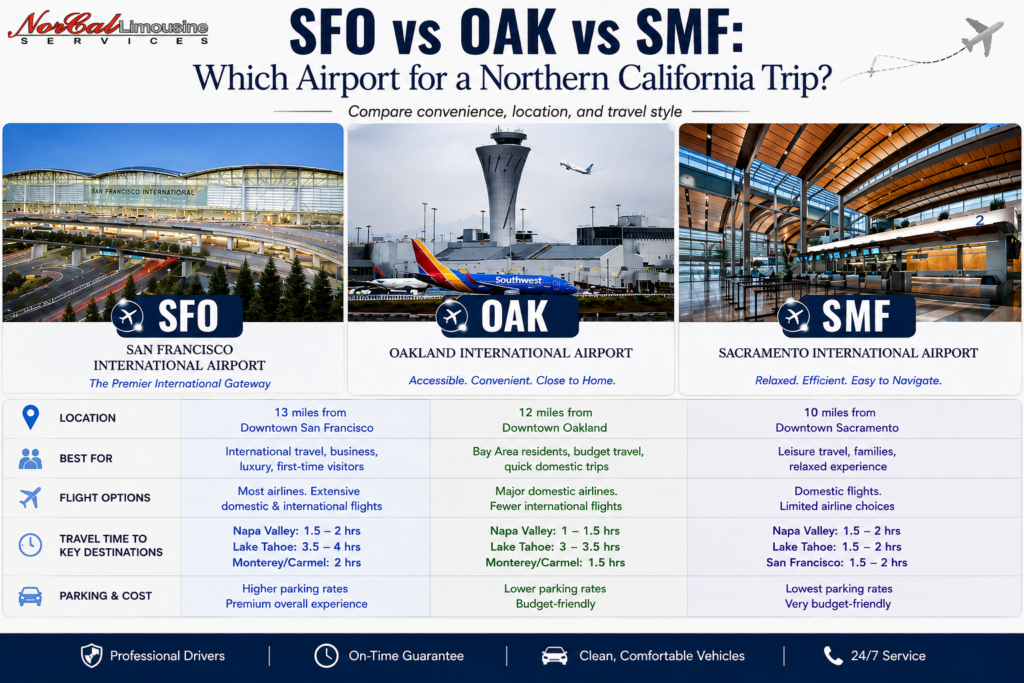
The three airports position very differently across this landscape:
- SMF — Sacramento’s local airport, gateway to Northern California for Central Valley travelers
- OAK — positioned in the East Bay, serving Oakland and the Bay Area from the east side
- SFO — 13 miles south of downtown San Francisco in San Mateo County, the region’s primary international hub
Sacramento International Airport (SMF) — Full Profile
Location and Access
SMF is located approximately 11 miles northwest of downtown Sacramento, easily reached via Interstate 5. There are no toll roads, no bridge crossings, and no Bay Area congestion on the approach. For Sacramento-area travelers — whether based in downtown Sacramento, Elk Grove, Roseville, Granite Bay, or Folsom — SMF is the straightforward local choice.
Travel time to Sacramento from SMF is about 15 to 20 minutes under normal traffic conditions. For early departures on domestic routes, this predictability is unmatched. No departure-morning traffic unknowns. No I-80 west of Fairfield. No Carquinez Bridge variables.
SMF is the closest airport to Sacramento, providing easy access to the Central Valley and the broader Northern California region. It also serves as a practical entry point for travelers arriving from the East Coast, Los Angeles, Mexico, and major domestic hub cities — then continuing by ground transport into the Bay Area or wine country.
Terminals and Airlines
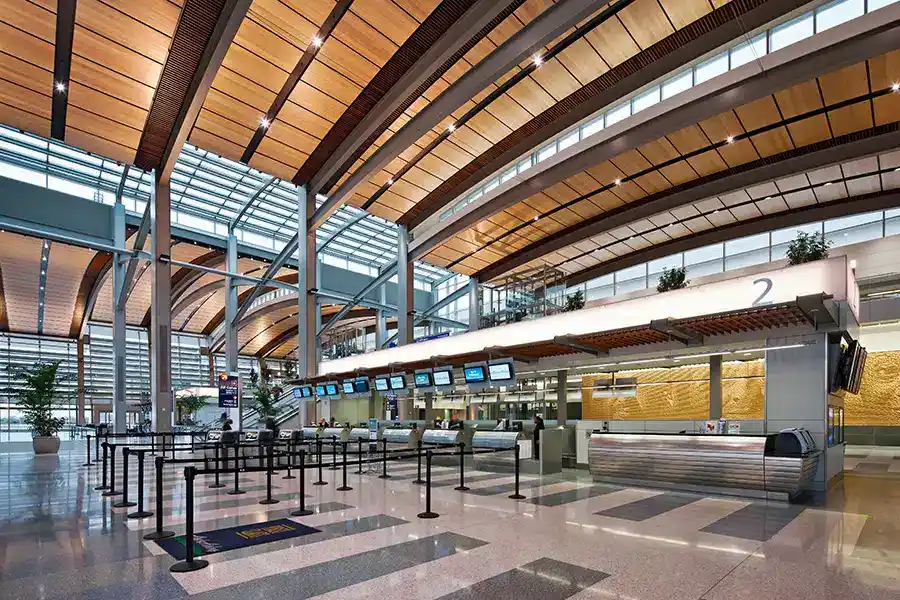
SMF is known for its user-friendly layout and ease of navigation with local dining options. The airport has two terminals and 32 total gates. Terminal A serves Delta, United, American, and Air Canada. Terminal B serves Southwest, Alaska, JetBlue, Frontier, Hawaiian, Aeromexico, and Volaris.
SMF typically has shorter security lines and faster ground transport than Bay Area major airports. In 2025, SMF handled just under 14 million passengers — making it the fourth busiest airport in California and a meaningfully sized operation despite its regional identity.
SMF focuses on domestic US destinations with limited international flights to Mexico and Canada. For travelers requiring non-stop international routes to Europe, Asia, or South America, SMF is not the right departure point. But for the vast majority of domestic travel connecting Sacramento to any Bay Area or nationwide destination, SMF covers the routes that matter.
Parking Rates at SMF
For a 5-day trip, SMF economy parking runs approximately $60 to $70 total.
SMF offers the lowest parking rates of the three airports. Economy parking caps at $14 per day with shuttle service. Daily lot parking maxes at $12 per 24-hour period. Garage parking — the closest option to both terminals — runs higher. All SMF parking is first-come, first-served with no advance reservation required.
Best For
SMF works best for Sacramento-region travelers on domestic routes, anyone prioritizing a short and predictable drive, corporate and business travelers with tight schedules, and families avoiding the complexity of Bay Area ground transportation.
Oakland International Airport (OAK) — Full Profile
Location and Access
Oakland International Airport is located about 10 miles south of downtown Oakland in the East Bay. From Sacramento, OAK is approximately 76 miles via Interstate 80 — crossing the Carquinez Bridge and navigating East Bay freeways before reaching the airport.
Travel time to Sacramento from OAK is about 1.5 to 2 hours depending on traffic. During weekday peak periods — westbound mornings and eastbound evenings — add 20 to 40 minutes. The Friday afternoon return from OAK to Sacramento during summer weekends is a variable worth planning for.
OAK is accessible by BART via the Oakland Airport Connector — an automated rail link to the Coliseum BART station and from there to downtown San Francisco, the East Bay, and the broader Bay Area transit network. For travelers whose Bay Area destination is BART-accessible, this is a genuine convenience.
OAK is positioned in the East Bay — making it closest to downtown Oakland, Berkeley, and East Bay destinations. For travelers heading to Redwood City, Santa Clara, or downtown San Francisco, the OAK approach requires crossing the Bay Bridge or navigating Bay Area freeways from the east side.
Terminals and Airlines
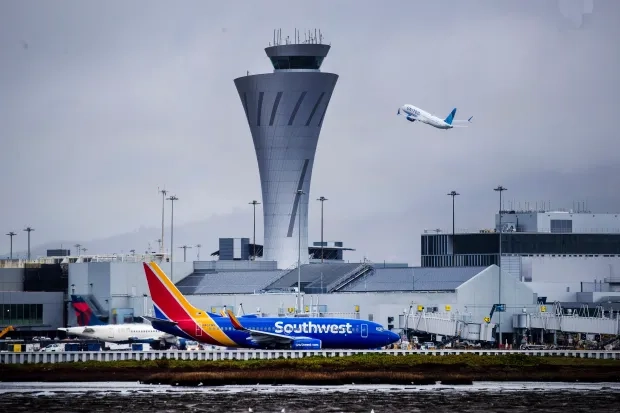
OAK has a compact terminal layout and standard amenities — fewer luxury options than SFO but a generally navigable experience. Terminal 1 completed a significant check-in lobby renovation in May 2025. The airport added 13 new restaurants and 5 new retail stores as part of ongoing improvements.
OAK is frequently used by budget travelers for its low-cost domestic flight options. Southwest Airlines is the dominant carrier, operating OAK as a primary base. Alaska, JetBlue, Delta, American, and international carriers including COPA Airlines also serve OAK. The airport primarily serves domestic routes and leisure flights to Mexico and Hawaii — with seasonal European service added in recent years.
Parking Rates at OAK
OAK’s Premier Lot — the closest to the terminals — charges a maximum of $40 per 24-hour period, effective July 1, 2025. The standard Hourly Lot maxes at $36 per day. For a 5-day trip, OAK parking runs $150 to $180 — meaningfully higher than SMF. OAK parking rates →
Best For
OAK suits travelers with Bay Area destinations on the East Bay side, those connecting via BART to downtown San Francisco or Silicon Valley, budget-conscious domestic travelers, and Sacramento-area travelers who find better fares on OAK routes than SMF.
San Francisco International Airport (SFO) — Full Profile
Location and Access
San Francisco International Airport is located about 13 miles south of downtown San Francisco in San Mateo County, near South San Francisco and Daly City on the peninsula. From Sacramento, SFO is approximately 86 miles — roughly 100 to 120 minutes under favorable conditions.
Travel time to Sacramento from SFO is typically 1.5 to 2.5 hours and can increase significantly during peak hours. The drive involves I-80 through the East Bay and either the Bay Bridge or the San Mateo Bridge. The Bay Bridge approach in particular is subject to some of the most unpredictable traffic in Northern California — including commute delays, bridge incidents, and surge periods around sporting events at venues in downtown Oakland and San Francisco.
SFO experiences more weather-related delays than the other airports. Bay Area coastal fog — concentrated on the peninsula where SFO sits — is a year-round factor. Travelers on tight schedules should plan departure timing conservatively when flying SFO, particularly in summer months when morning fog delays are common.
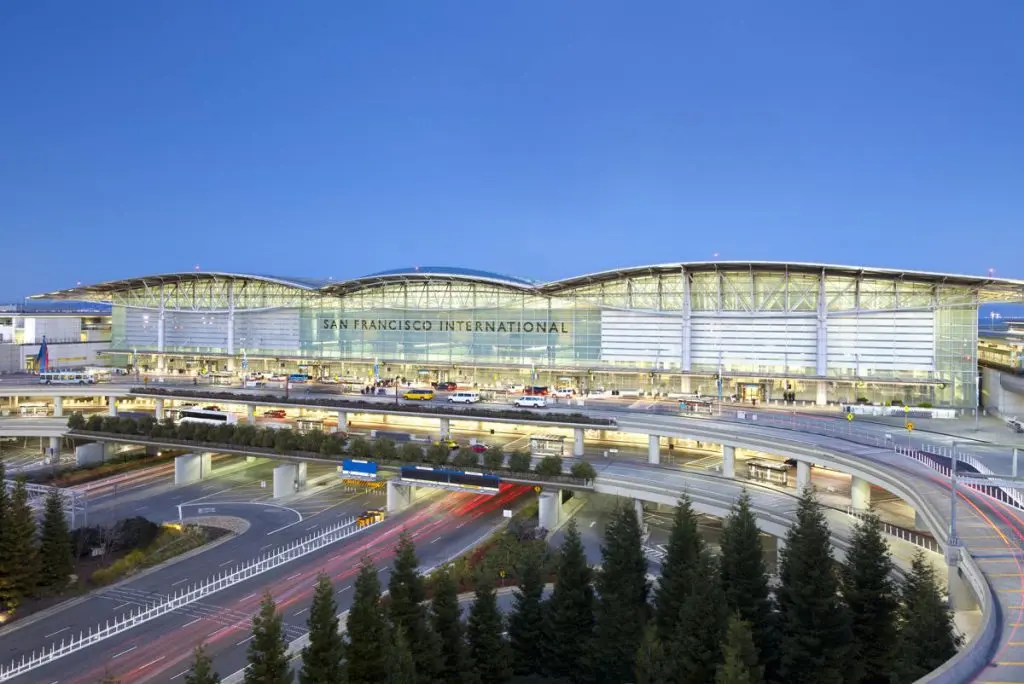
SFO is often praised as one of the best airports in the US for its terminal design, international food halls, and modern facilities. The scale and quality of the airport are genuine — but they come with corresponding navigation complexity and security wait times that exceed SMF and OAK. SFO’s size can lead to longer security lines and navigation challenges, especially during peak travel periods.
Terminals and Airlines
SFO operates four terminals — Terminal 1, Terminal 2, Terminal 3, and the International Terminal — connected by the AirTrain system. The airport is a major hub for United Airlines and Alaska Airlines, and serves the full spectrum of international carriers with non-stop service to Europe, Asia, Australia, Latin America, and beyond.
SFO offers the widest flight network including both domestic and long-haul international flights. SFO has the most direct flights among Bay Area airports and among the three major airports in this comparison. For non-stop international flights from Northern California, SFO is typically the only realistic option. SFO and OAK are accessible by BART — SFO has its own dedicated BART station inside the International Terminal, accessible via the AirTrain.
Parking Rates at SFO
On-site parking at SFO ranges from $25 per day at the Long Term lot to $45 per day for valet. For a 5-day trip, on-site SFO parking runs $125 to $225 — the highest of the three airports by a significant margin.
Best For
SFO is the right choice for international travel, travelers requiring United or Alaska hub connections, those flying directly into or out of San Francisco, and business travelers attending meetings in downtown San Francisco or on the peninsula.
The San Jose Factor
San Jose airport — Norman Y. Mineta San Jose International (SJC) — is not one of the three major airports in this comparison, but it is a relevant reference for Bay Area travelers. San Jose is a one-hour drive from San Francisco. SJC has fewer crowds compared to SFO and OAK and is the natural choice for travelers heading to Silicon Valley, Santa Clara, East Palo Alto, and the South Bay.
Critically, SFO and OAK are accessible by BART; San Jose is not. SJC does not have direct BART rail service — reaching the broader Bay Area public transit network from SJC requires bus connections. For Sacramento-area travelers, SJC is rarely the most practical option — SMF offers equivalent domestic convenience without the 2-hour Bay Area drive. But for travelers whose final destination is specifically the Silicon Valley corridor, SJC is worth checking alongside SFO.
Drive Times from Sacramento-Region Cities
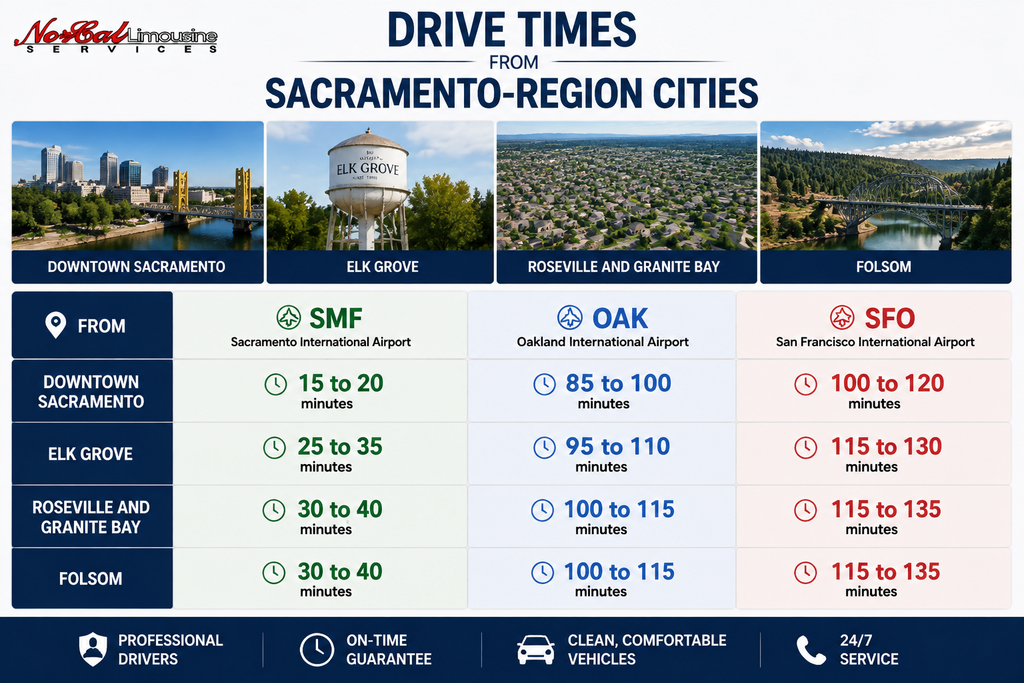
Drive times vary by origin. Here are realistic estimates in light-to-moderate traffic for the most common Sacramento-region starting points.
From Downtown Sacramento
- SMF: 15 to 20 minutes
- OAK: 85 to 100 minutes
- SFO: 100 to 120 minutes
From Elk Grove
- SMF: 25 to 35 minutes
- OAK: 95 to 110 minutes
- SFO: 115 to 130 minutes
From Roseville and Granite Bay
- SMF: 30 to 40 minutes
- OAK: 100 to 115 minutes
- SFO: 115 to 135 minutes
From Folsom
- SMF: 30 to 40 minutes
- OAK: 100 to 115 minutes
- SFO: 115 to 135 minutes
During peak Bay Area commute hours — westbound 7 to 9am and eastbound 4 to 7pm — add 20 to 45 minutes to OAK and SFO estimates. Add additional buffer during summer weekends, ski season, and Bay Area event days. SMF drive times remain stable — no bridge, no Bay Area congestion, no variable approach.
Parking Rates: Side-by-Side Comparison
| Airport | Economy/Daily (per day) | Garage (per day) | 5-Day Economy Cost |
|---|---|---|---|
| SMF | $12–$14 | $19+ | ~$60–$70 |
| OAK | $36 max | $40 max | ~$150–$180 |
| SFO | $25 (Long Term) | $36–$45 | ~$125–$225 |
The parking rates difference between SMF and SFO over a 5-day trip reaches $100 to $150 for a single traveler. For a corporate team of 4 — each driving separately — that multiplies to $400 to $600 in parking alone. A confirmed private group transfer frequently costs less than four SFO parking spots for the same trip duration.
Airline Coverage: What Each Airport Offers
SMF
Ten airlines serve SMF non-stop, covering 51 destinations in 3 countries. Southwest carries more than half of all SMF passengers. Major domestic hubs — Los Angeles, Las Vegas, Seattle, Phoenix, Denver, Chicago, New York, and East Coast cities — are all served with multiple daily departures. International coverage includes Mexico via Aeromexico and Volaris, and seasonal Canada service via Air Canada.
For domestic US travel, SMF covers nearly every relevant route. For non-stop international travel beyond Mexico and Canada, SMF’s options are limited.
OAK
OAK’s network is smaller than SFO’s but covers the most popular domestic routes effectively. Southwest dominates, with Alaska, JetBlue, Delta, American, and COPA adding coverage. OAK primarily serves domestic routes and leisure flights to Mexico and Hawaii, with seasonal European service. OAK is frequently used by budget travelers for its low-cost domestic flight options — particularly on Southwest routes where fares are often competitive.
SFO
SFO offers the widest flight network — domestic and long-haul international flights spanning Europe, Asia, Australia, Latin America, and beyond. SFO has the most direct flights among the three major airports in Northern California. It is a United Airlines hub and a major Alaska Airlines hub, with international carriers including Lufthansa, British Airways, Air France, Japan Airlines, and dozens more.
For any itinerary requiring a non-stop international departure from Northern California, SFO is almost always the only option among the three Bay Area airports.
Bay Area Destinations: Which Airport Puts You Closest
Your destination within the entire Bay Area should influence your airport choice as much as your departure city.
Downtown San Francisco: SFO is closest. OAK via BART is competitive — 30 minutes by rail to the city. SMF is 100 to 120 minutes by private transfer.
Silicon Valley and Santa Clara County: SFO is closest to Silicon Valley hubs. SJC is nearest to Santa Clara, East Palo Alto, and Redwood City — but rarely the most practical option for Sacramento-area travelers.
East Bay — Oakland, Berkeley, Contra Costa County: OAK is the natural choice. BART from OAK connects efficiently across the East Bay network.
Marin County: SFO and OAK are roughly equidistant. Neither has direct BART access to Marin — a private transfer is required regardless of airport.
Napa Valley and Sonoma County: SMF is the most practical airport. Napa Valley is approximately 60 miles from SMF — no Bay Area bridge traffic. From SFO or OAK, the Napa drive runs 60 to 90 minutes depending on conditions. For wine country trips from Sacramento, SMF saves time on both ends.
San Pablo, Suisun City, and Central Valley destinations: SMF is the natural gateway. These communities sit well within SMF’s ground transportation reach — and far from both Bay Area airports.
Seasonal Considerations for Bay Area Airport Travel
Summer
Bay Area coastal fog — heaviest in summer mornings on the SFO peninsula — causes more weather-related delays at SFO than at OAK or SMF year round. Summer weekends bring increased Bay Area bridge traffic. Add buffer time for SFO and OAK drives during peak summer periods.
Winter and Ski Season
For Sacramento-area travelers connecting to Lake Tahoe or Sierra Nevada ski areas, SMF is the practical departure airport. The I-80 Tahoe corridor runs from Sacramento, not from the Bay Area.
Holiday Periods
Bay Area airports experience peak congestion during Thanksgiving, Christmas, and spring break. SMF’s shorter drive and simpler terminal are meaningful advantages. Plan SFO security time generously during holidays.
Year-Round Business Travel
For recurring Silicon Valley corporate travel, SFO is usually the most direct option. For Sacramento-based executives flying elsewhere and returning the same day, SMF eliminates the Bay Area round trip entirely.
Best Airport by Trip Type
Corporate travel and business meetings → SMF first. Predictable drive, lowest parking rates, shortest security lines.
International flights → SFO. The only realistic option for most non-stop international departures from Northern California.
Bay Area leisure — East Bay → OAK. BART access and competitive fares for East Bay and downtown San Francisco via transit.
Napa Valley and Sonoma County wine trips → SMF. No Bay Area congestion. The most time-efficient gateway to Northern California wine country.
Downtown San Francisco → SFO direct, or OAK via BART. OAK saves on parking rates if driving and returning.
Marin County → OAK or SFO — roughly equal by car. A private transfer is the practical solution.
Silicon Valley and Santa Clara County → SFO for most routes, OAK for Southwest fares.
Budget domestic travel → OAK. Southwest fares are frequently the most competitive in the region.
Professional Transportation: Covering Any Airport, Any Group
Airport choice is decision one. Airport transportation is decision two — and they interact.
NorCal Limo provides confirmed private professional transportation to SMF, OAK, SFO, and RNO from Sacramento, Elk Grove, Granite Bay, Roseville, Folsom, and El Dorado Hills. Every transfer is point-to-point, flat rate, and confirmed before your travel date. Your chauffeur monitors your flight — early landings, delays, and gate changes are all managed.
For corporate teams heading to Silicon Valley or downtown San Francisco, a confirmed private transfer removes both the parking cost and the traffic variable. For families on international routes through SFO, the Sprinter handles the luggage load. For wine tour groups to Napa Valley or Sonoma County, the vehicle stays with your group all day.
TCP 31143-P. $1.5 million in commercial insurance. Every airport. Every route.
📞 (916) 905-4665 | 📩 info@norcalimo.com | Book Your Transfer →
Frequently Asked Questions
What is the difference between SFO vs OAK vs SMF for Northern California travelers?
The key differences are drive time, parking rates, and flight coverage. SMF is fastest from Sacramento — 15 to 20 minutes — with the lowest parking rates. OAK offers BART access and competitive budget fares, roughly 90 minutes from Sacramento. SFO has the most international flights but the longest drive — 100 to 120 minutes — and the highest parking rates of the three.
Which airport is closest to downtown San Francisco and the San Francisco Bay Area?
SFO is approximately 13 miles south of downtown San Francisco in San Mateo County — closest to the city itself. OAK sits in the East Bay, about 22 miles from San Francisco by road, with BART access making transit to the city competitive. SMF is Sacramento’s local airport and the gateway to the San Francisco Bay Area for Central Valley travelers.
Is San Jose airport worth considering alongside SFO and OAK from Sacramento?
For most Sacramento-area travelers, San Jose airport (SJC) is not the most practical option. San Jose is a one-hour drive from San Francisco, and SJC does not have BART access — limiting transit options. However, for travelers specifically heading to Silicon Valley, Santa Clara, or Redwood City destinations, SJC is worth checking alongside SFO. From Sacramento, the drive to SJC is comparable to SFO — 105 to 130 minutes.
Which Bay Area airport is best for Napa Valley and Marin County trips?
For Napa Valley, SMF is the best option from Sacramento — no Bay Area bridge traffic. From any Bay Area airport, the Napa drive adds 60 to 90 congestion-dependent minutes. For Marin County, OAK and SFO are roughly equidistant by car. Neither has direct public transit access to Marin — a private transfer is the practical solution from any of the three airports.
How do international flights differ at SFO vs OAK vs SMF?
SFO has the most international flights — serving Europe, Asia, Australia, and Latin America non-stop. It is the region’s primary hub for long-haul routes. OAK has limited international service: Mexico, Hawaii, and seasonal European routes. SMF offers international flights to Mexico and Canada only. For any non-stop international departure from Northern California, SFO is the correct choice.
TCP 31143-P · Insured to $1.5M · NLA Member · Serving Sacramento Since 2013 SMF · SFO · OAK · Sacramento · Elk Grove · Granite Bay · Roseville · Napa Valley · Sonoma County · Silicon Valley · Downtown San Francisco