By NorCal Limo Editorial Team | Sacramento, CA
Key Takeaways
- The Sacramento-to-SFO drive takes 90 to 110 minutes under light traffic — and 2.5 to 3.5 hours during peak weekday commute windows
- San Francisco International Airport recommends arriving 2 hours before domestic flights and 3 hours before international departures
- The Bay Bridge is the single most unpredictable segment — plan specifically around it
- SFO experiences more weather-related delays than comparable California airports — fog on the peninsula is a year-round factor
- Active road construction on I-80, I-5, and US-50 adds real variability to every Sacramento departure this fall
- A confirmed private transfer removes the planning burden entirely — your chauffeur monitors the route live
Introduction
The Sacramento-to-SFO route looks simple on a map. Interstate 80 west. Bay Bridge. US-101 south. Exit at SFO. On a clear Tuesday midmorning, the whole thing takes about 95 minutes. You arrive relaxed, check your bag, and walk to your gate.
On a Friday afternoon in late August, leaving at 2pm, that same route can take over three hours. Construction on I-80 has dropped lanes near Vacaville. The Bay Bridge is stacking from the toll plaza back to the maze. You arrive at San Francisco International Airport with 42 minutes before departure and spend 30 of them in the TSA line.
This guide gives you the timing framework to avoid that scenario entirely. We cover drive times by hour and day, active road conditions affecting the Sacramento-to-SFO corridor, what to expect at SFO airport once you arrive, and the specific planning factors most Sacramento travelers overlook — including noise abatement procedures, international operations, and how SFO’s terminal layout affects your actual gate-arrival time. The answer to “how early should I leave” depends on more variables than most people account for. This guide covers them all.
Understanding San Francisco International Airport
Location and Scale
San Francisco International Airport is located approximately 14 miles south of downtown San Francisco in San Mateo County, accessible primarily via US-101 from the north and I-280 from the peninsula corridor. For Sacramento-area travelers, US-101 is the standard final approach — reached via I-80 west and the Bay Bridge.
SFO handled 54.5 million passengers in 2025 and ranks among the top 15 busiest airports in the country. It serves as a major hub for both United Airlines and Alaska Airlines, with more than 50 carriers connecting the Bay Area to over 140 destinations worldwide.
That scale matters for departure planning. The sheer volume of passengers, aircraft, and ground vehicles at SFO means that every step of the landside experience — parking, check-in, security, gate access — takes longer than at a smaller airport like SMF.
Terminal Layout and Gates
SFO has a distinctive circular layout with four terminal buildings: Harvey Milk Terminal 1, Terminal 2, Terminal 3, and the International Terminal, divided into Boarding Areas A and G.
Terminal 1 (Harvey Milk Terminal) — Alaska Airlines and American Airlines domestic operations, plus some Delta flights.
Terminal 2 — Alaska Airlines, American, and Delta. Known among frequent flyers for strong dining and design.
Terminal 3 — United Airlines domestic and Hawaii flights, plus United Express regional services. Note: as of late 2025, Terminal 3’s AirTrain station is closed during renovation. The Terminal 2 stop now serves both terminals. United passengers departing D and E gates check in at Terminal 2; F-gate passengers check in at Terminal 3. Always verify your check-in location on the day of departure.
International Terminal (Boarding Areas A and G) — Long-haul international operations including Lufthansa, Air France, Japan Airlines, and dozens of other carriers. Walking time between the A and G gates can reach 20 to 25 minutes. Use the AirTrain for transfers between far international boarding areas.
The AirTrain System
The free AirTrain runs 24 hours a day with frequent departures. It connects all terminals, the rental car center, and the BART station. Wait time is typically a few minutes during peak hours.
The AirTrain Red Line reaches the BART connection in about 9 minutes. From Terminals 1, 2, and 3, take elevators or escalators to the Mezzanine Level and follow the signs.
If you are dropped off at the wrong terminal — which happens often with taxi and rideshare service — the AirTrain corrects the mistake within minutes without requiring a security re-screen, as long as you board landside before clearing security.
BART Access
BART weekday airport service runs from 4:58am (first train departing SFO) to midnight. Weekend Saturday service begins at 5:47am. Sunday service begins at 8:08am — make alternative airport travel plans if you need to catch an early morning Sunday flight.
The BART station at SFO is located at the International Terminal. For travelers arriving by BART from San Jose, Oakland, or other Bay Area points, the BART station connects directly to the AirTrain for the terminal transfer. BART is not a practical option for Sacramento-origin travelers departing by car — but for return trips or for passengers connecting from elsewhere in the Bay Area, it is the cleanest ground option.
Noise Abatement Procedures and Flight Schedules
SFO operates under specific noise abatement procedures that affect runway use and departure routing at certain hours. The airport’s position between the San Francisco Bay to the east and residential neighborhoods to the west means that departure and arrival directions are managed carefully — particularly during nighttime and early morning hours.
For travelers, this is relevant when flights are delayed or rerouted. An aircraft holding for noise abatement compliance may push your departure time, especially on overnight and pre-dawn flights. SFO also manages international operations from the International Terminal separately from domestic flows — if your connecting flight involves a terminal switch between domestic and international, account for AirTrain time on both ends.
SFO experiences more weather-related delays than other airports. Bay Area coastal fog — concentrated on the peninsula where SFO sits — is a year-round factor. Summer mornings are the most fog-affected period. Check SFO‘s weather and delay status the morning of your departure at flysfo.com.
The Drive: Sacramento to SFO
Standard Route: I-80 West to Bay Bridge to US-101 South
For the vast majority of Sacramento-area travelers, the route is: I-80 west from Sacramento through Davis, Vacaville, Fairfield, and Vallejo — then across the San Francisco-Oakland Bay Bridge — then south via US-101 (or I-380) to SFO airport.
The Bay Bridge is the least forgiving stretch of the entire route. Off-peak, the crossing takes 35 to 50 minutes from the East Bay approach. During weekday rush hour — roughly 7 to 10am and 4 to 7pm — that commonly stretches to 55 to 80 minutes.
Between Sacramento and the Bay Bridge, the corridor from Vacaville through Vallejo stacks during commute windows. A single crash, debris incident, or lane closure on this stretch adds 30 to 60 minutes with no viable alternate until the south I-5 option.
Alternate Route: I-5 South to I-580 West
When I-80 shows heavy bridge backups, consider taking I-5 south to I-580 west through the Altamont Pass, connecting via the San Mateo Bridge to SFO. The route is approximately 40 miles longer but can cut trip time in half during heavy weekend traffic.
This alternate bypasses the Bay Bridge and approaches SFO from the southeast via the San Mateo Bridge. Check Google Maps or Waze before committing — on Sunday evenings and holiday weekends when Tahoe-bound traffic is returning westbound, the I-5/I-580 route is frequently faster despite the additional distance.
How Early to Leave: By Departure Hour
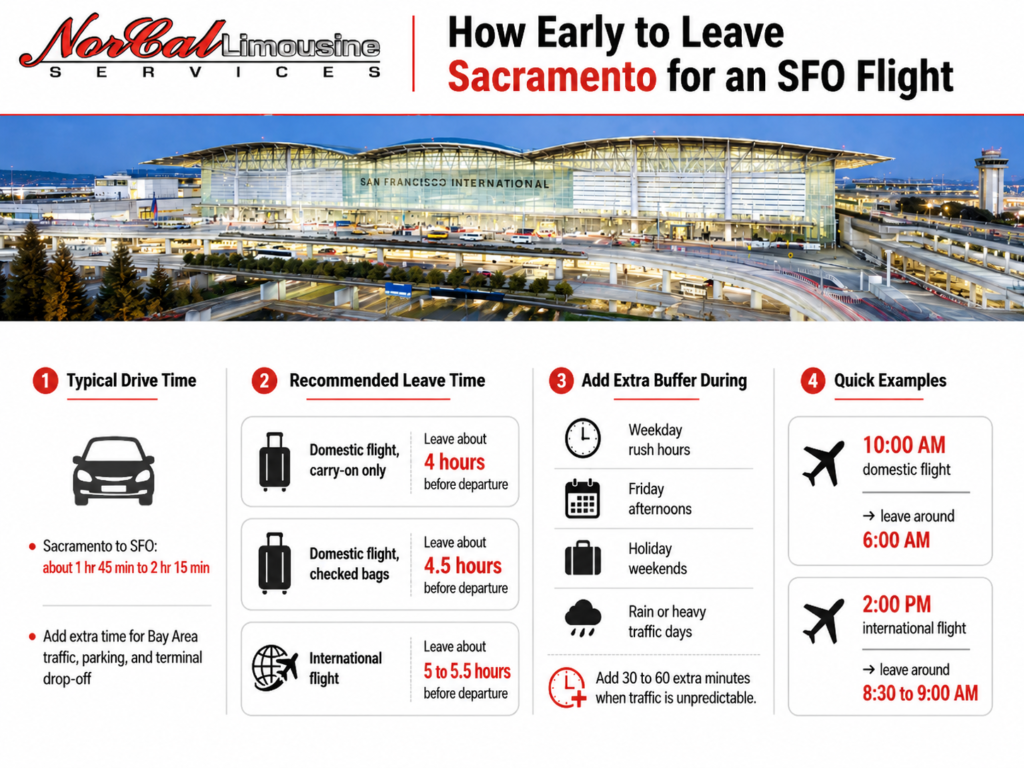
All estimates below start from central Sacramento. Add 15 to 30 minutes for Elk Grove, Roseville, Granite Bay, or Folsom origins. All assume you need to arrive at SFO with the FAA-recommended buffer in place.
Flights Before 8am
Estimated leave time: 4 to 4.5 hours before departure
Early morning flights are logistically demanding. The airport is quiet but your departure window is unforgiving. For a 6am flight, leave Sacramento no later than 1:30am. For a 7am flight, leave by 2:30am.
SFO recommends arriving 2 hours before domestic departures and 3 hours before international ones. <cite index=”62-1″>Travelers are advised to arrive at SFO at least 2 hours before domestic flights and 3 hours for international flights to navigate check-in and security with ease.</cite>
For pre-dawn departures, a confirmed private transfer with a professional chauffeur is particularly valuable. Your driver handles the route while you prepare for the flight. There are no navigation apps to monitor at 2am, no parking ramp circuits to navigate, and no uncertainty about whether you left on time.
Flights 8am to 11am
Estimated leave time: 3.5 to 4.5 hours before departure
This is the highest-risk window on a weekday. Leaving Sacramento at 6:30am puts you in westbound I-80 traffic during its most congested period. The Bay Bridge approach commonly runs 70 to 80 minutes during this window.
For a 10am flight, leaving Sacramento at 5:30 to 6am gives you the best balance of road traffic and SFO arrival timing. If active construction has dropped lanes on I-80 — which is the case this August and September — add an additional 20 to 30 minutes.
Flights 11am to 2pm
Estimated leave time: 3 to 3.5 hours before departure
Midday is the most reliable departure window. Traffic on I-80 eases significantly between 9:30am and 2pm on weekdays. The Bay Bridge moves well. A 95 to 110-minute drive is realistic.
Leave 3 full hours before your flight. If your check-in is at the International Terminal or requires an AirTrain transfer, budget an additional 15 minutes on the airport side.
Flights 2pm to 7pm
Estimated leave time: 3.5 to 5 hours before departure
This is the single most dangerous window for missed flights on this route. <cite index=”48-1″>Leaving at 3pm, you will hit expanding commuter traffic and arrive in the Bay Area most likely between 4:30 and 6pm — right in the core of evening Bay Bridge backup.</cite>
For a 5pm flight on a Friday in August or September, leave Sacramento by 11:30am. A 3-hour drive can stretch past 4.5 hours in peak conditions. Monitor your navigation app from the moment you leave and be prepared to switch to the I-5/I-580 alternate if I-80 is stacking at Vacaville.
Flights After 7pm
Estimated leave time: 2.5 to 3 hours before departure
Evening flights offer more ground-side flexibility. Traffic on I-80 generally eases after 6:30 to 7pm on weekdays. For an 8pm flight, leaving Sacramento at 5pm gives you a 3-hour buffer as traffic is beginning to ease. Still check for incidents — a crash on I-80 west of Fairfield at 5pm can hold the corridor for 90 minutes.
Active Road Conditions: August to September 2026
The following active construction closures affect the Sacramento-to-SFO corridor. Conditions change daily — verify before every departure at Caltrans QuickMap →
I-80 — Lane closed for survey work. The primary route for SFO-bound travelers from Sacramento. Even a single closed lane during peak hours causes meaningful backup through the corridor.
I-5 — 4 lanes closed for utility work (multiple windows in August and September). If you plan to use the I-5 south alternate route, verify lane standing before committing.
US-50 — 4 lanes closed for fiber optic installation. US-50 feeds into the Sacramento grid before reaching I-80. Closures affect surface access from Sacramento’s east and southeast quadrants.
SR-99 — 1 lane closed for striping. Travelers from South Sacramento and Elk Grove using SR-99 to access I-80 west should add 10 to 15 minutes during peak periods.
SR-12 — 1 lane closed for electrical work. SR-12 connects Fairfield and Vallejo — a critical segment of the I-80 SFO corridor — dropping capacity at a section that is already congested during peak hours.
What to Expect at SFO Once You Arrive
Curbside Drop-Off and Ground Transportation
If you are being dropped off by a private transfer, chauffeur, or rideshare, SFO has dedicated arrival ramp areas at each terminal. Your driver should know your terminal in advance — if dropping at the wrong terminal, the AirTrain corrects it landside.
Long-term parking at SFO is available at the Domestic Garage, International Garage, and surface lots, with rates ranging from $25 to $45 per day depending on proximity and lot type. For multi-day trips, long-term parking costs at SFO can reach $125 to $225 over 5 days — a meaningful variable compared to SMF’s $60 to $70 economy lot option. SFO parking information →
Security and TSA Lines
SFO operates security checkpoints at each terminal. During morning peak — 6 to 10am — standard lanes run 20 to 40 minutes. TSA PreCheck and CLEAR reduce this substantially. During international operations peaks, International Terminal security can run longer given the added complexity of passport verification and international screening requirements.
From Security to Gate
Allow 15 to 20 minutes to cross between far ends of adjoining terminals once through security. Walking time from A gates to G gates in the International Terminal is 20 to 25 minutes — use the AirTrain for faster transfers between the two international boarding areas.
Check your airline app on the morning of departure for your specific terminal and gate assignment. SFO occasionally reassigns flights between terminals. Knowing your gate before you arrive at the airport saves significant time on the landside.
San Jose and Bay Area Airport Alternatives
For travelers whose final destination or connection point is in the South Bay, San Jose International Airport (SJC) is worth checking alongside SFO. San Jose is a one-hour drive from San Francisco. San Jose airport has fewer crowds compared to SFO and OAK.
From Sacramento, the drive to San Jose airport runs 110 to 135 minutes — comparable to SFO and without the Bay Bridge crossing. SJC does not have BART access, but the overall airport experience is less congested than SFO for domestic departures.
For travelers catching international operations or specific airline connections, SFO is almost always the necessary choice — the international network at SFO airport has no equivalent in the Bay Area. But for domestic flights on Southwest, Alaska, or American where San Jose and SFO both serve the route, SJC’s smaller size frequently means faster security and faster ground transit on the airport side.
Departure Timing Reference Table
| Flight Time | Day | Leave Sacramento By |
|---|---|---|
| 6am domestic | Any | 1:30am |
| 7am domestic | Any | 2:30am |
| 9am domestic | Weekday | 4:30am–5:00am |
| 11am domestic | Weekday | 7:30am–8:00am |
| 1pm domestic | Weekday | 9:30am–10:00am |
| 3pm domestic | Weekday | 10:00am–10:30am |
| 5pm domestic | Weekday | 12:30pm |
| 5pm domestic | Friday Aug/Sep | 11:00am–11:30am |
| 8pm domestic | Any weekday | 5:00pm–5:30pm |
| Any international | Any | Add 30 min + arrive 3 hours early |
Check Caltrans QuickMap and your navigation app live before every departure. Estimated times are based on typical conditions — lane closures, incidents, and weather can shift any of these by 30 to 90 minutes.
Professional Transportation: When the Variables Are Managed for You
Every section of this guide covers a variable that is ultimately outside your control once you are on the road. The Bay Bridge backs up when it backs up. Lanes close when Caltrans schedules them. Fog rolls in over the San Francisco Bay Area peninsula without advance notice.
NorCal Limo provides confirmed private transfers from Sacramento to San Francisco International Airport — departing from your door, arriving curbside at your terminal. Your chauffeur monitors live traffic on your route before and during the trip. If I-80 is stacking near Vacaville, the alternate route via I-5 and the San Mateo Bridge is already in play. If a lane closure has compounded near Fairfield, your driver knows before you reach that point.
For travelers with early morning departures — 4am taxi time, 5am leave — a professional transfer means stepping into a confirmed vehicle. No warming up your car in the dark. No monitoring a navigation system at 3am. No standing in an airport parking ramp with your bags, trying to locate the shuttle to your terminal.
For corporate travelers or groups heading to SFO for international flights, the Mercedes Sprinter keeps everyone together. No convoy. No three separate vehicles dealing with three separate long-term parking situations at one of California’s busiest airports.
The reliability of a scheduled departure is the point. NorCal Limo’s service is built around it.
📞 (916) 905-4665 | 📩 info@norcalimo.com | Book Your Transfer →

Frequently Asked Questions
How early should I arrive at San Francisco International Airport for my flight?
San Francisco International Airport recommends arriving at least 2 hours before domestic flights and 3 hours before international departures. SFO handles over 54 million passengers annually across four terminals. Security lines during peak morning hours typically run 20 to 40 minutes. If your gate requires an AirTrain transfer, add another 10 to 15 minutes. TSA PreCheck reduces security wait times substantially at SFO airport.
How long is the drive from Sacramento to SFO airport?
Under light traffic, the Sacramento-to-SFO drive takes 90 to 110 minutes via I-80 and the Bay Bridge. During weekday peak hours — 7 to 9am and 4 to 7pm — it regularly takes 2.5 to 3.5 hours. SFO is 14 miles south of downtown San Francisco. Always check a live navigation app before departure and add at least 30 to 60 minutes beyond your estimated time.
What are the international operations at SFO airport that affect my departure?
SFO airport handles international operations from the International Terminal — Boarding Areas A and G — with carriers including Lufthansa, Air France, Japan Airlines, and dozens more. International check-in and security take longer than domestic. Noise abatement procedures affect early morning routing. Arrive 3 hours before any international flight and verify your terminal and gate on your airline’s app.
Is San Jose airport a better option than SFO for Bay Area flights from Sacramento?
For some itineraries, yes. San Jose is a one-hour drive from San Francisco with shorter security lines and fewer crowds than SFO. From Sacramento, the drive runs 110 to 135 minutes — comparable to SFO. San Jose suits domestic travelers on Southwest, Alaska, or American where both airports serve the route. For international operations and long-haul connections, SFO airport is the necessary choice.
What should I know about SFO’s terminal layout before arriving?
SFO airport has four terminals: Harvey Milk Terminal 1, Terminal 2, Terminal 3, and the International Terminal. Each has its own security checkpoint. The free AirTrain connects all terminals and the BART station around the clock. Walking between far gates takes 20 to 25 minutes. Terminal 3’s AirTrain station is currently closed — Terminal 2’s stop now serves both terminals.
TCP 31143-P · Insured to $1.5M · NLA Member · Serving Sacramento Since 2013 Sacramento · Elk Grove · Granite Bay · Roseville · Folsom · SMF · SFO · OAK